
Affiliate disclosure: Smart Gear Select may earn a commission from qualifying purchases made through affiliate links on this page, at no additional cost to you. As an Amazon Associate, we earn from qualifying purchases.
This is a research-based review. Smart Gear Select evaluates official manufacturer specifications, current retailer information, product positioning and practical buyer considerations. We do not claim hands-on testing unless explicitly stated.
📌 The Bottom Line
The Anker 737 Power Bank (PowerCore 24K) remains a capable high-output portable charger for laptop users, travelers, students, creators and professionals who carry several USB-powered devices.
Its strongest features are a 24,000mAh battery capacity, up to 140W total output, two USB-C ports, one USB-A port and a smart digital display that provides useful charging information.
The Anker 737 is larger and heavier than a typical phone-focused power bank, but that is the trade-off for laptop-class charging capability and substantially greater battery capacity.
In 2026, it should be treated as an established premium power bank rather than automatically assumed to be Anker’s newest or best option. Its value depends on current pricing compared with newer high-output alternatives.
Smart Gear Select verdict: Still worth considering if you need 140W USB-C charging and 24,000mAh capacity and can find it at a competitive price.
Anker 737 Power Bank (PowerCore 24K)
Check current pricing and availability for the standalone Anker 737 Power Bank.
Prices, stock and sellers may change. Verify that the listing is for the standalone Anker 737 Power Bank (PowerCore 24K), ASIN B09VPHVT2Z, before purchasing.
Anker 737 Technical Specifications
| Feature | Specification |
|---|---|
| Product | Anker 737 Power Bank (PowerCore 24K) |
| Capacity | 24,000mAh |
| Maximum Total Output | 140W |
| USB-C Ports | 2 |
| USB-A Ports | 1 |
| Total Outputs | 3 |
| USB-C Charging | Supports high-power USB-C charging including Power Delivery 3.1 |
| Display | Smart digital charging display |
| Dimensions | Approximately 155.7 × 54.6 × 49.5 mm |
| Weight | Approximately 630g |
| Best For | USB-C laptops, tablets, phones, travel and multi-device work setups |
⚡ 140W USB-C Charging
The defining feature of the Anker 737 is its ability to provide up to 140W maximum total output.
Anker uses USB-C Power Delivery technology, including PD 3.1 support, allowing compatible laptops and other high-power devices to draw considerably more power than they could from a typical phone-focused power bank.
That makes the 737 useful for devices such as compatible MacBooks, Windows ultrabooks, tablets and smartphones.
However, seeing “140W” on the box does not mean every device will charge at 140W.
To reach the highest supported rate, the connected device and USB-C cable must also support the necessary Power Delivery specification and power level.
Anker specifically notes that a compatible PD 3.1 cable and device are required to achieve the maximum 140W rate.
🔋 24,000mAh Capacity
The 24,000mAh capacity gives the Anker 737 substantially more stored energy than compact 5,000mAh or 10,000mAh power banks.
That extra capacity is useful when charging laptops, tablets and several devices during the same trip.
It is important, however, not to interpret the advertised capacity as a guarantee of an exact number of full device charges.
Real usable energy varies because of voltage conversion, charging losses, temperature, cable efficiency and the battery characteristics of the device being charged.
A smartphone may receive several meaningful top-ups, while a large laptop battery can consume a substantial portion of the Anker 737’s available energy.
📟 Smart Digital Display
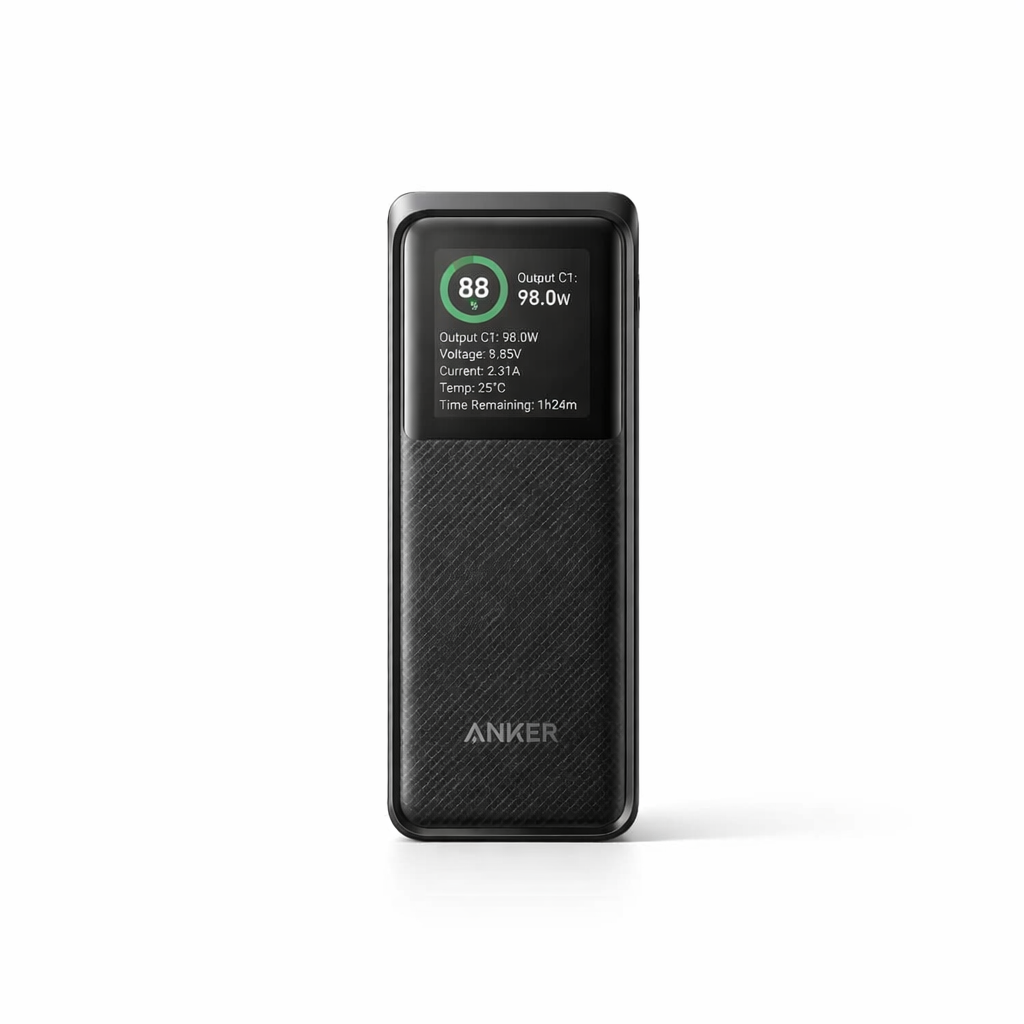
The built-in smart digital display is one of the features that separates the Anker 737 from basic battery packs.
Instead of relying only on four LED dots, the screen can provide information related to battery level and charging activity.
This is especially useful when charging high-power equipment because you can see more clearly how the power bank is behaving.
For laptop users, creators and people managing several devices, that information can be genuinely useful rather than purely decorative.
🔌 Two USB-C Ports and One USB-A Port
The Anker 737 provides three charging outputs:
- 2 × USB-C ports
- 1 × USB-A port
The USB-C ports are the main high-power connections and are the logical choice for modern laptops, tablets and smartphones.
The USB-A connection remains useful for older cables, accessories and devices that have not moved entirely to USB-C.
The power bank can charge several devices at once, but the 140W specification refers to maximum total output. It does not provide 140W independently from every port when several devices are connected simultaneously.
🔄 High-Power Recharging
The Anker 737 supports high-power input as well as high-power output.
Anker describes the product as supporting 140W two-way fast charging, meaning a sufficiently powerful compatible USB-C charger can recharge the power bank much faster than a basic phone charger.
Your actual recharge time depends on the wall charger and cable being used.
A low-power USB-C phone adapter will therefore not recharge the Anker 737 at its maximum supported rate.
💻 Is the Anker 737 Good for Laptop Charging?
Yes — laptop charging is one of the strongest reasons to buy the Anker 737.
Many modern laptops support USB-C Power Delivery, allowing them to charge from compatible external power banks.
The 737’s maximum 140W output makes it suitable for a much broader range of USB-C computers than conventional low-output portable batteries.
Compatibility still matters.
Some laptops use proprietary charging systems, and others may accept USB-C power but at a lower rate than their original charger.
Check your laptop manufacturer’s USB-C charging requirements if maintaining maximum performance while charging is important.
📏 Size and Weight
Anker lists the 737 at approximately 155.7 × 54.6 × 49.5 mm and around 630g.
That makes it substantially heavier than a pocket-size power bank.
It is better suited to a laptop bag, backpack or travel bag than a trouser pocket.
For buyers who only need emergency phone charging, carrying this much battery and weight may not make sense.
For people carrying a laptop, tablet, phone and accessories, the trade-off becomes easier to justify.
✈️ Air Travel and Power Bank Rules
Power banks require special attention when flying because they are treated as spare lithium batteries.
FAA guidance states that power banks and spare lithium-ion batteries must be carried in the aircraft cabin rather than checked baggage.
The general lithium-ion limit is 100Wh per battery without airline approval. Larger batteries between 101Wh and 160Wh may require airline approval and are subject to additional restrictions.
Before flying with any power bank, check the battery’s Wh marking and your airline’s current policy.
Do not assume that being allowed under a general aviation rule guarantees every airline or country will apply identical procedures.
✅ Who Should Buy the Anker 737?
The Anker 737 is particularly well suited to:
- USB-C laptop users
- Remote workers
- Students carrying laptops and tablets
- Frequent travelers
- Content creators working away from mains power
- People carrying multiple devices every day
- Buyers who value detailed charging information
For these users, the combination of battery capacity and high-output USB-C charging can be much more useful than a lightweight phone-only power bank.
❌ Who Should Skip It?
The Anker 737 is excessive if you only want an emergency charger for a smartphone.
A smaller 10,000mAh or 20,000mAh power bank will generally be easier to carry.
You may also want to compare newer high-output power banks if they are selling at similar prices.
The Anker 737 remains capable, but an established premium product is not automatically the best current value simply because it has strong specifications.
If you are considering an older Anker battery product, also read our Anker PowerCore 10000 recall warning and verify the exact model number before buying or traveling with it.
⚖️ Pros & Cons
| Pros | Cons |
|---|---|
| Up to 140W total output | Heavy compared with phone-focused power banks |
| Large 24,000mAh capacity | More expensive than basic models |
| Two USB-C ports | Only three total outputs |
| USB-A compatibility | No built-in wireless charging |
| Useful smart digital display | Maximum output requires compatible hardware and cable |
| Suitable for many USB-C laptops | Not all laptops accept their maximum power over USB-C |
Is the Anker 737 Still Worth Buying in 2026?
Yes — if the price and your power requirements make sense.
The Anker 737 has not become obsolete. A 24,000mAh battery, 140W maximum output, three charging ports and smart display remain useful specifications.
What has changed is the competitive landscape.
Newer premium power banks now compete for the same buyers, so the 737 should be judged on current price rather than its reputation when originally released.
If you need laptop-class USB-C output and find the 737 at a competitive price, it remains a strong option.
🎯 Final Verdict
The Anker 737 Power Bank (PowerCore 24K) remains one of the more capable established high-output power banks for people who need to charge more than a phone.
Its strongest combination is straightforward: 24,000mAh capacity, up to 140W total output, two USB-C ports, one USB-A port and a smart digital display.
The downsides are its weight, size and premium positioning compared with simpler power banks.
Smart Gear Select recommendation: Consider the Anker 737 if you genuinely need laptop-class USB-C charging and find it at a competitive price. If newer high-output alternatives cost roughly the same, compare them before purchasing.
Check current Anker 737 availability
Verify ASIN B09VPHVT2Z, product condition, seller and included accessories before purchasing.
🔗 Related Buying Guides
- Top 15 Trending Tech Products of 2026
- Best Laptops of 2026
- Laptop Guides and Reviews
- Anker PowerCore 10000 Recall Warning
👨💻 About the Author
Arif Bukera is Tech Lead at Smart Gear Select, where he works on editorial strategy and research across consumer electronics, computers, wearable technology, smart-home devices and everyday technology accessories.
This article uses research-based product evaluation and published manufacturer specifications. Smart Gear Select does not claim hands-on testing unless that testing is explicitly stated.
📧 Contact: arif@smartgearselect.com