
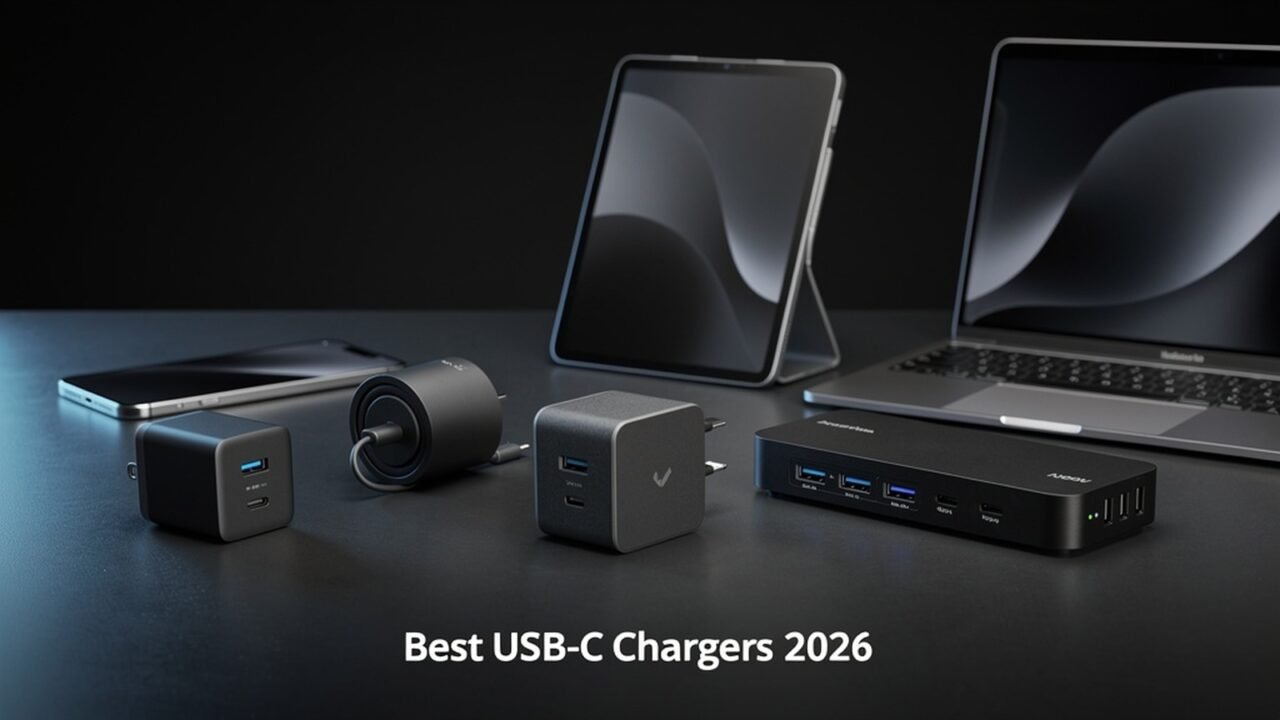
Best USB-C Chargers for Phones and Laptops in 2026

Buying guide status: Research-based. Smart Gear Select has not hands-on tested every charger included in this guide. Recommendations are based on current manufacturer specifications and independent testing from established technology publications. See our review methodology.

Affiliate disclosure: Smart Gear Select may earn a commission from qualifying purchases through affiliate links. As an Amazon Associate, Smart Gear Select earns from qualifying purchases. This does not increase the price you pay or affect our editorial assessment.

πŸ“Œ The Bottom Line

The best USB-C charger in 2026 depends on what you actually need to power.

If you mainly charge a smartphone, a compact 30W charger is usually enough. If you want one charger for a phone, tablet and lightweight laptop, the 65W–67W range offers a strong balance of portability and power. For larger laptops or several devices, a 100W or higher multi-port charger makes more sense.

Our current shortlist:

  • Anker Nano 3 30W β€” Best compact phone charger
  • Baseus EnerCore CJ11 67W β€” Best midrange travel charger
  • UGREEN Uno 100W β€” Best versatile 100W charger
  • Anker Nano 130W 6-Port β€” Best multi-device desk charger
ChargerMaximum OutputBest ForPorts / Connections
Anker Nano 330WPhones & travel1 Γ— USB-C
Baseus EnerCore CJ1167WPhone + laptop travel3 USB-C connections, including retractable cable
UGREEN Uno100WLaptop + multiple devicesMulti-port
Anker Nano 130W130W totalDesk / multi-device setup4 Γ— USB-C + 2 Γ— USB-A

1. Anker Nano 3 30W β€” Best Compact USB-C Charger

The Anker 511 Charger (Nano 3) 30W is a straightforward choice for people who mainly charge phones and smaller USB-C devices.

It provides a single USB-C port with up to 30W output and supports PPS charging. Anker lists output profiles up to 20V/1.5A and PPS support up to 30W.

Independent charger testing has also found the Nano 3 particularly consistent for sustained output and thermal behavior within the low-power category.

Best for:

  • Google Pixel phones
  • Samsung Galaxy phones
  • iPhones using USB-C
  • earbuds
  • smartwatches
  • tablets
  • travel

Why we like it

  • Very compact
  • 30W USB-C output
  • PPS support
  • Easy to carry
  • Established charger manufacturer

Consider something larger if: you need to charge a higher-powered laptop or several devices simultaneously.


Check Anker Nano 3 30W Price on Amazon

2. Baseus EnerCore CJ11 67W β€” Best Midrange Travel Charger

The Baseus EnerCore CJ11 67W is more versatile because it combines higher output with an integrated retractable USB-C cable.

Baseus rates it for up to 67W total output and says it can power three devices simultaneously.

The built-in retractable USB-C cable is particularly useful for travel because it reduces the number of loose cables you need to carry.

Independent testing has also found the CJ11 capable of maintaining its rated output while managing heat well within the 65W–67W class.

Best for:

  • MacBook Air and similar USB-C laptops
  • phones
  • tablets
  • Steam Deck and compatible handhelds
  • business travel
  • people who dislike carrying separate cables

Why we like it

  • 67W output
  • Retractable USB-C cable
  • Multi-device charging
  • Foldable plug on compatible regional versions
  • Compact GaN design

Important: connecting several devices can change how the charger distributes its total available power.


Check Baseus EnerCore CJ11 Price on Amazon

3. UGREEN Uno 100W β€” Best Versatile 100W Charger

The UGREEN Uno 100W provides substantially more headroom for users who need to power a laptop alongside phones and accessories.

UGREEN rates its Uno charger for up to 100W output through its highest-powered USB-C connection and says it can charge up to four devices at once.

Unlike many anonymous black charging bricks, the Uno also has a distinctive robot-inspired design and a small display showing charging-status expressions.

Best for:

  • USB-C laptops
  • phones and tablets
  • multi-device users
  • home-office setups
  • travelers wanting one higher-power charger

Why we like it

  • Up to 100W output
  • Multiple ports
  • GaN design
  • Can replace several smaller chargers
  • Status display

A 100W charger does not mean every connected device receives 100W. Available power is shared according to the charger’s port-allocation rules.


Check UGREEN Uno 100W Price on Amazon

4. Anker Nano 130W 6-Port β€” Best Desk Charging Station

If you regularly have several devices on one desk, the Anker Nano Charger 130W 6-Port is designed for a different job than a normal wall adapter.

It provides up to 130W total output across:

  • 4 USB-C ports
  • 2 USB-A ports

Anker rates USB-C1 for up to 100W and USB-C2 for up to 65W when the applicable power configuration allows it.

This makes it useful for a desk containing a laptop, smartphone, tablet, earbuds, smartwatch and other accessories.

Best for:

  • home offices
  • content creators
  • multi-device workstations
  • shared charging areas
  • users replacing several power bricks

Why we like it

  • Six charging ports
  • 130W total output
  • Up to 100W from USB-C1
  • PPS support
  • Detachable AC power cable
  • Designed for desktop use


Check Anker Nano 130W Charger on Amazon

30W vs 65W vs 100W: How Much Power Do You Need?

20W–30W

Usually sufficient for:

  • smartphones
  • wireless earbuds
  • smartwatches
  • smaller tablets

45W–67W

A useful middle ground for:

  • phones
  • larger tablets
  • many thin-and-light laptops
  • portable gaming devices

For many users, this range offers the best balance between size and versatility.

100W and Above

Consider a higher-output charger for:

  • higher-powered USB-C laptops
  • several devices at once
  • large power banks
  • desktop setups
  • replacing multiple charging bricks

Do not automatically buy the highest wattage. Match the charger to the devices you actually own.

What Is a GaN Charger?

GaN stands for gallium nitride.

Gallium-nitride power components can help manufacturers create compact, high-power chargers with greater power density than many older charger designs.

In practical terms, a modern GaN charger can often provide substantial output without requiring an oversized power brick.

GaN alone does not guarantee charger quality. Thermal management, electrical protection, certification and manufacturer quality still matter.

What Is USB Power Delivery?

USB Power Delivery (USB-PD) allows compatible USB-C devices and chargers to negotiate appropriate voltage and power levels.

The same charger can therefore supply different amounts of power depending on whether you connect a smartphone, tablet or laptop.

Your device determines how much compatible power it requests. A 100W charger does not force 100W into a phone.

What Is PPS Charging?

PPS stands for Programmable Power Supply.

It allows compatible chargers to dynamically adjust voltage and current within supported ranges.

PPS is particularly important for achieving certain fast-charging modes on compatible Samsung Galaxy phones and other Android devices.

Check your phone manufacturer’s charger requirements before assuming that every USB-C charger supports its maximum charging speed.

Do You Need a Special USB-C Cable?

Possibly.

The charger is only one part of the charging system.

For higher USB-C Power Delivery levels, your cable must also support the required current and wattage. Some high-power modes require an electronically marked USB-C cable.

Check:

  • charger rating
  • cable rating
  • device charging specification

before expecting the maximum advertised charging speed.

Can One Charger Power a Phone and Laptop?

Yes, if the charger has sufficient total output and the appropriate USB-C ports.

For example, a multi-port 100W charger may allocate most of its available power to a laptop while providing a smaller amount to a phone.

Power allocation can change when another device is connected or removed. This is normal behavior for multi-port chargers.

Should You Avoid Very Cheap Unknown Chargers?

A charger handles mains electricity and can be connected to devices worth hundreds or thousands of dollars.

For that reason, we prefer products from manufacturers that clearly publish:

  • output specifications
  • supported charging standards
  • safety information
  • warranty terms
  • power-sharing behavior

A suspiciously cheap high-output charger with unclear technical information may not be worth the risk.

Which USB-C Charger Should You Buy?

Choose the Anker Nano 3 30W if you mainly charge a smartphone and want maximum portability.

Choose the Baseus EnerCore CJ11 67W if you want one travel charger that can cover a phone and many USB-C laptops.

Choose the UGREEN Uno 100W if you need more laptop power and multiple-device capability.

Choose the Anker Nano 130W 6-Port if you want a single desktop charging hub for several devices.

Final Verdict

There is no single USB-C charger that is best for every user.

The most useful approach is to choose enough power for your devices without paying for capacity you will never use.

For most phone-only users, 30W is sufficient.

For users carrying a laptop as well, 65W–100W is generally more flexible.

For a desk with several devices, a 100W+ multi-port charger can replace several separate adapters.

Smart Gear Select recommendation: Check wattage, USB-PD support, PPS requirements, port configuration and cable capability rather than choosing a charger based only on the largest number printed on the box.


Compare USB-C Chargers on Amazon

Price note: Retail prices, availability and seller terms change frequently. Check the retailer for current pricing, shipping and warranty information.


Sources & Further Reading

Last reviewed: August 2026.

Leave a Comment

Your email address will not be published. Required fields are marked *

Scroll to Top