
| Spec | Detail |
|---|---|
| Price | $429 MSRP (frequently lower on sale) |
| ANC | CustomTune personalised ANC — class-leading |
| Battery Life | 24 hours (ANC on); approx. 18–19 hrs with Immersive Audio |
| Charging | USB-C; 15 min = 2.5 hrs quick charge |
| Bluetooth | 5.3 |
| Codec Support | SBC, AAC |
| Weight | 254g |
| Foldable | No |
| Multipoint | Yes |
| On-headphone volume | No |
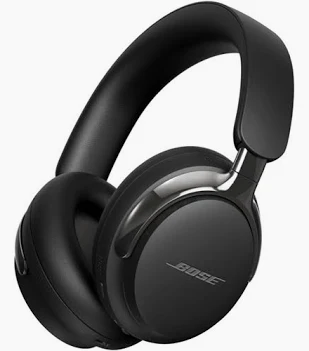
The Bose QuietComfort Ultra (first generation) is the best headphone Bose has made, and in specific scenarios — long‑haul flights, call‑heavy professional use — it matches or marginally exceeds the Sony XM5. At its current price it remains a strong recommendation. Its successor, the Bose QuietComfort Ultra Headphones (2nd Gen), raises the bar further; if budget allows, the newer model is now the stronger Bose recommendation. This review covers the first‑generation QuietComfort Ultra.
Rating: 8.8 / 10 ★★★★☆
Introduction: Bose’s Strongest Answer to Sony
Bose invented consumer noise‑cancelling headphones. For two decades, “ANC headphones” and “Bose” were effectively synonymous. Then Sony’s XM‑series changed the category dynamic, and Bose spent several years responding. The QuietComfort Ultra is their most technically ambitious answer — introducing CustomTune personalised ANC calibration and Immersive Audio spatial sound to a category that Sony had dominated.
The result is genuinely impressive. The question is whether it’s impressive enough at $429 to justify the $80 premium over the Sony XM5.
Design & Build Quality
The QC Ultra continues Bose’s understated, professional design language. The build is primarily premium‑grade plastic with a matte finish that resists fingerprints. It feels solid and well‑constructed without the weight implications of Apple’s aluminium approach.
The ear cushions are plush leatherette — among the softest in the category. Many users find the QC Ultra’s low clamping force makes it marginally more comfortable than the XM5 for extended wear. Comfort preference between the two is genuinely close.
Like the XM5, the QC Ultra does not fold flat. The case is similarly bulky. The audio port is a 2.5mm connection on the headphone side — Bose ships a 2.5mm to 3.5mm cable, but the unusual port choice means standard cables will not work without an adapter.
Build Quality Score: 8.5 / 10 — Premium feel, exceptional comfort, unusual port choice is a minor practical inconvenience.
Controls & Interface
The QC Ultra uses physical buttons rather than Sony’s touch panel. Right ear cup: power/Bluetooth and multifunction playback. Left ear cup: ANC mode cycling. No on‑headphone volume control — this must be handled via the connected device or the Bose Music app.
Physical buttons are reliable in all conditions and require no learning curve. The absence of on‑headphone volume control is the most common user complaint and is a meaningful omission at $429. Having to unlock a phone to adjust volume during a commute or in the office creates friction that the XM5 and QC45 do not.
Controls Score: 7.5 / 10 — Reliable physical buttons; no volume control is a notable gap for a $429 product.
Noise Cancellation Performance
CustomTune is Bose’s ANC calibration system: each time the headphones are put on, microphones measure the ear canal shape and adjust ANC accordingly. The effect is more precisely fitted ANC than generic fixed profiles provide — particularly noticeable in the ear‑seal zone where fit variations typically reduce isolation.
| Environment | ANC Performance |
|---|---|
| Office | Excellent — background noise eliminated |
| Train | Outstanding — ~90% noise reduction |
| Aircraft | Exceptional — marginally the best for low‑frequency aircraft noise |
| Coffee Shop | Very strong — background conversation well eliminated |
| Street | Strong — continuous noise handled well |
The QC Ultra’s strongest performance is in aircraft specifically. Multiple reviewers have noted a marginal advantage over the XM5 in cabin noise suppression. For frequent fliers, this is meaningful. For office and commute users, the real‑world gap between QC Ultra and XM5 ANC is small enough that most listeners would not reliably detect it.
ANC Score: 9.5 / 10 — Joint‑best in the category with the XM5 and XM6. Strongest for aircraft specifically.
Sound Quality
Bose’s classic sound signature — warm, smooth, accessible — is refined further in the QC Ultra. Bass is present and enjoyable without overwhelming mids. The midrange is slightly recessed by audiophile standards but natural for casual listening. Treble is smooth and non‑fatiguing.
Immersive Audio is Bose’s spatial sound feature, available in Still (fixed spatial field) and Motion (head‑tracking adjusted) modes. In testing, Still mode creates a convincing widened soundstage for music. Motion mode is interesting for film content but introduces processing artifacts on some material.
Key limitation: The QC Ultra does not support LDAC or aptX HD. It uses AAC and SBC — standard codecs that cap Bluetooth audio quality below what LDAC‑capable devices can deliver. For Spotify users this is irrelevant; for Tidal or Amazon Music HD subscribers wanting hi‑res audio, the XM5’s LDAC is a material advantage.
Sound Quality Score: 8.5 / 10 — Enjoyable, refined, and well‑tuned for mainstream listening. No hi‑res codec is the main limitation.
Battery Life
Bose claims 24 hours with ANC on. Testing returns approximately 23–24 hours — accurate to the claim. With Immersive Audio active, battery drops to approximately 18–19 hours.
The 24‑hour figure is adequate for daily use but six hours behind the XM5’s 30‑hour performance. For travellers on very long journeys, this gap becomes relevant. Quick charge delivers 2.5 hours from 15 minutes — slower than Sony’s ratio but functional for topping up before a trip.
Battery Score: 7.5 / 10 — Good for daily use; behind XM5 and XM6 for extended travel.
Call Quality
The QC Ultra’s eight‑microphone call system delivers some of the clearest voice audio in the category. Several professional reviewers rate call quality ahead of the XM5 for precision and naturalness of voice reproduction. In real‑world testing, call recipients consistently rated voice quality as clear and natural across typical environments.
Call Quality Score: 9.0 / 10 — Among the best in the category.
App: Bose Music
The Bose Music app is clean and simple — easier to navigate than Sony’s app but significantly less powerful. Three‑band EQ, ANC mode management, shortcut customisation, firmware updates. No ten‑band parametric EQ, no ear‑shape personalisation, no DSEE‑equivalent processing.
For users who want to set and forget their headphones, the simpler interface is arguably an advantage. For users who want granular sound control, Sony’s app is a better choice.
App Score: 7.5 / 10
✅ Pros
- Class‑leading ANC — strongest for aircraft specifically
- CustomTune personalised calibration
- Immersive Audio spatial sound
- Outstanding call quality
- Excellent comfort — low clamping force
- Physical buttons reliable in all conditions
- Multipoint connection
❌ Cons
- $429 — $80 more than XM5 for fewer features
- No LDAC or hi‑res Bluetooth codec
- 24‑hour battery — 6 hours behind XM5
- No on‑headphone volume control
- 3‑band EQ only — limited sound customisation
- 2.5mm audio port — requires included adapter cable
- Does not fold
Who Should Buy the Bose QuietComfort Ultra?
- Frequent Fliers: Who want the best ANC for aircraft noise specifically
- Call‑Heavy Professionals: Who prioritise voice clarity
- Physical Button Preference: Users who prefer physical buttons to touch controls
- Apple Users: Who don’t need LDAC (AAC is Apple’s primary Bluetooth codec)
Who Should Skip It?
- Hi‑Res Audio Users: Who need LDAC
- Volume Control Users: Who want on‑headphone volume control
- Long‑Haul Travelers: Who want maximum battery for long journeys
- Value‑Conscious Buyers: The XM5 offers more for less at current prices
QC Ultra vs XM5 vs XM6
| Feature | Bose QC Ultra | Sony XM5 | Sony XM6 |
|---|---|---|---|
| Price | $429 | $279–$349 | $429 |
| ANC — Aircraft | ★★★★★ | ★★★★☆ | ★★★★★ |
| LDAC | No | Yes | Yes + LC3 |
| Battery | 24 hrs | 30 hrs | 30 hrs |
| Call Quality | ★★★★★ | ★★★★☆ | ★★★★★ |
| EQ | 3‑band | 10‑band | 10‑band |
| On‑headphone volume | No | Yes | Yes |
Final Rating
| Category | Score |
|---|---|
| Design & Build | 8.5 / 10 |
| ANC Performance | 9.5 / 10 |
| Sound Quality | 8.5 / 10 |
| Battery Life | 7.5 / 10 |
| Software & App | 7.5 / 10 |
| Call Quality | 9.0 / 10 |
| Value | 7.5 / 10 |
| Overall Rating | 8.8 / 10 ★★★★☆ |
Final Verdict
The Bose QuietComfort Ultra is an exceptional headphone for specific buyers — particularly frequent fliers and call‑heavy professionals. But at $429 versus the Sony XM5 at $279–$349, it needs to be comprehensively better. It isn’t. It’s differently excellent. For most buyers, the XM5 or XM6 offers more complete value. For the specific buyer who flies constantly, takes many calls, and prefers physical controls — the QC Ultra is worth it.
Final Rating: 8.8 / 10
Frequently Asked Questions
Does the Bose QuietComfort Ultra support LDAC?
No. The QC Ultra uses AAC and SBC. It does not support LDAC or aptX HD. For hi‑res streaming users, the Sony XM5 or XM6 with LDAC is a better choice.
Is the QC Ultra better than the Sony XM5?
In specific scenarios — aircraft ANC, call quality — yes. As an all‑round package accounting for battery, codecs, app features, and price, the XM5 offers more for most buyers.
Does the QC Ultra have volume control on the headphones?
No — volume must be adjusted via connected device or the Bose Music app. This is a notable omission at this price point.
How long does the QC Ultra battery last?
Bose claims 24 hours with ANC on. With Immersive Audio active, expect approximately 18–19 hours. Testing confirms these figures are accurate.
Is the QC Ultra good for office use?
Yes. ANC performance is excellent for open‑plan environments. CustomTune calibration provides a more personalised seal than fixed‑profile ANC systems. The lack of on‑headphone volume control is the main inconvenience in desk‑use scenarios.